The Project Marrow Discovery
The CEO’s Baby Girl: A Workplace Reverse Harem Romance (Age-Gap Billionaire Obsessions)The Project Marrow Discovery is the decisive revelation in which Ariella Monroe learns that her relationship with Dominic Vale was engineered before their first meeting. The discovery turns the apparent seduction at Vale Enterprises into evidence of prior selection and transforms the magical bond from an intimate danger into an experiment whose human cost includes a terminated predecessor, unnamed secondary candidates, and the possible destruction of memory itself.
Causes and Hidden Preparation
The discovery occurs after Ariella has already been drawn deeply into Dominic’s world. Her first arrival at Vale Enterprises places her inside a space defined by wealth, hierarchy, and concealed menace: the company rises into an office of glass and steel, where Dominic sits behind a black marble desk veined with gold. Even before the archive is found, the relationship is framed through his control of her body and conduct. His disciplinary language treats her arousal as unauthorized and presents obedience as something he can regulate. The later file therefore does not introduce control into an otherwise equal relationship; it reveals that the control had a prior institutional and magical design.
Jenna’s warning supplies an earlier human account of the same pattern. She tells Ariella about a previous intern who entered Dominic’s orbit believing she had obtained the job of her dreams, only to be taken and twisted into whatever fantasy he was pursuing. Jenna’s account identifies the vanished young woman as both an employee and a vulnerable predecessor, while also emphasizing the asymmetry between Dominic’s authority and the women recruited into it. The warning is incomplete: Jenna knows what happened to the last girl, but not the full mechanism behind it. Project Marrow later gives that disappearance a clinical vocabulary.
The immediate trigger is a message from an unknown number received while Ariella is still physically marked by her intimacy with Dominic. The message states that Dominic did not bind her to protect her, but to control what he had broken, and directs her to the vault beneath the library and to Luca for information about Project Marrow. Its anonymous form makes the warning both vulnerable and powerful: the sender cannot yet be identified, but the message provides a precise path to material evidence. It redirects Ariella from Dominic’s explanations toward a concealed location and a named project.
Entry into the Vault
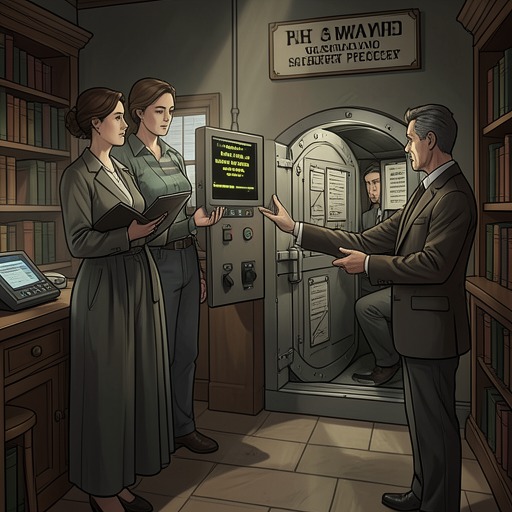
Ariella follows the instruction to the hidden chamber beneath the library. She had never seen the vault and had not known that it existed, which makes the architecture itself part of the revelation. At the back wall, her fingers find a seam that had previously been invisible. When she touches the central symbol, a vertical slash through a crescent moon, the wall trembles and opens. The dormant sigils and the cold air that emerges suggest a space deliberately sealed away rather than an ordinary room accidentally overlooked.
The chamber is small and circular, lined with shelves holding scrolls, files, and strange black orbs that pulse faintly inside glass cages. Its contents combine administrative recordkeeping with occult containment. The room is not merely a hiding place for a single secret; it is an archive of magical procedures and controlled materials. At its center stands a pedestal bearing one thick file, directing Ariella’s attention from the chamber’s many unknowns to a document whose label identifies her as its subject.
The label reads “PROJECT MARROW: SUBJECT A.001.” That designation is the first explicit indication that Ariella has been classified before she understands herself as a participant. The code removes her from the language of romance and places her within a sequence of subjects, while the file’s position at the center of the vault gives the discovery the force of an arranged confrontation with the past.
What the File Reveals
Inside the file are aged, grainy photographs of a young woman bound in ritual and marked in a way that resembles Ariella’s own marking. The woman is pale, tear-streaked, and beautiful, but her eyes are empty. The visual resemblance links Ariella to an earlier subject before the report explains the connection. The photograph also answers part of Jenna’s warning: the previous girl was not simply lost from the workplace or from Dominic’s life. She was subjected to a ritual process that left a visible mark and an emptied expression.
The report describes the process in dry clinical terms. It states that a subject shows accelerated magical adaptation when bonded with the Primary, that intimacy significantly amplifies latent channels, and that emotional attachment appears unnecessary for the bond to function. The report further records that the subject was terminated after attempting a breach, with secondary candidates pending. This language is crucial because it separates magical efficacy from affection. The bond does not require love according to the document; intimacy is treated as a method for increasing power, and the subject’s emotional life is reduced to an irrelevant variable.
The word “terminated” confirms the predecessor’s fate while concealing the precise manner of death or destruction. The phrase “secondary candidates pending” expands the threat beyond the photographed woman and Ariella. She is not an isolated exception but one position within a planned succession. The archive’s categories reveal a system capable of selecting, testing, discarding, and replacing women while preserving the process in records that Dominic controls.
Ariella finds further pages filled with arcane equations, diagrams, and spells bearing her name in fresh ink. The freshness of the writing contrasts with the aged photographs and proves that the project has not ended with the earlier subject. Her name was written before she arrived and before she met Dominic. The file thus carries evidence of both continuity and premeditation: the old subject belongs to the project’s history, while Ariella has already been entered into its future.
Reversal of Meaning and Aftermath
The discovery produces a reversal in Ariella’s understanding of Dominic’s motives. She had experienced the relationship as a dangerous mixture of attraction, discipline, and surrender, and the surrounding narrative had allowed his interest to appear personal even when it was coercive. The file replaces that interpretation with a colder one. Dominic chose her long ago not because he had felt drawn to her, but because he had planned her. The distinction is the emotional center of the event: desire may have seemed to explain his attention, but the archive reveals prior design.
The discovery also changes the meaning of the binding. Dominic’s claim that the bond was protective is contradicted by the anonymous message and by the project’s documentation. The binding becomes a technology of control, intended to manage what Dominic had broken rather than safeguard Ariella from danger. The archive therefore exposes not only a secret experiment but a conflict over who has the authority to name an act: protection from Dominic’s perspective, control from the evidence’s perspective.
The later fate of Isadora Vale provides a stark parallel to the archive’s treatment of magical subjects. Isadora’s magic implodes, leaving her unconscious, powerless, and without memory. That outcome gives the Project Marrow Discovery retrospective reach: the story repeatedly associates magical power with the ability to alter bodies, minds, and records. The vault preserves selected traces of the past, while magical force can erase the person who carried it. What survives in the archive is consequently not neutral history but history preserved by the stronger party.
The discovery does not immediately resolve Ariella’s relationship with Dominic. Instead, it supplies the knowledge that makes any later confrontation possible. She now knows that the apparently private bond has institutional precedents, that a previous subject was terminated after resistance, and that her own name was prepared in advance. Her uncertainty is no longer limited to whether Dominic desires her; it extends to whether the intimacy was ever allowed to become personal at all.
Narrative Significance
As a plot event, The Project Marrow Discovery combines the discovery and reversal patterns: an apparently intimate romance is reclassified as a premeditated magical program. The anonymous message functions as the clue, the hidden seam and crescent-marked mechanism as the threshold, and the file as the material answer. The progression from warning, to vault, to photograph, to report, to fresh writing produces an escalation from rumor to documentation.
The event also makes knowledge itself a form of power. Jenna possesses testimony about the previous girl, the anonymous sender possesses enough information to direct Ariella, Luca is named as a possible source, and Dominic’s vault contains the formal record. None of these forms of knowledge is complete on its own. Ariella must move between spoken warning and written archive to reconstruct the system that has classified her. The project’s language claims objectivity, but its categories erase the subjects’ voices; the archive records what was done to them without preserving their consent or explanation.
Its deepest consequence is the collapse of the distinction between being chosen and being designed. Ariella’s identity as a magical partner, her marked body, and the intimacy that amplifies her latent channels are revealed as elements of a plan made before her arrival. The fact that she later becomes pregnant does not erase this origin; it intensifies the stakes by showing that the planned bond has consequences extending into reproduction and inheritance. The Project Marrow Discovery therefore stands as the book’s central exposure of controlled history: Dominic’s power depends not only on binding bodies, but on deciding which version of their past will be believed.